
😯 “Come on, sweetheart. Pick it up,” the Command Sergeant Major said as he threw my passport into the mud in front of the entire camp. He had no idea that I wasn’t just an ordinary translator—or what my passport actually represented.
On my first day at the camp, I noticed the looks from the other soldiers. The Command Sergeant Major, in particular, clearly didn’t like me at all.
One day, he took my passport and threw it into the mud in front of everyone. Then he ordered me to pick it up with a contemptuous smile, convinced that no one would dare intervene.
I bent down without saying a word and retrieved the document. Several soldiers looked away, while a few officers seemed to realize that something was wrong.
The Command Sergeant Major continued to provoke me. He said I needed to learn to respect the chain of command. According to him, I was nothing more than a civilian who had come to translate a few confidential meetings.
What he didn’t know, however, was that the passport he had just soiled was not an ordinary document. Above all, he had no idea that my true identity was known to only a handful of people at the camp.
The full story is in the article in the first comment 👇👇👇.
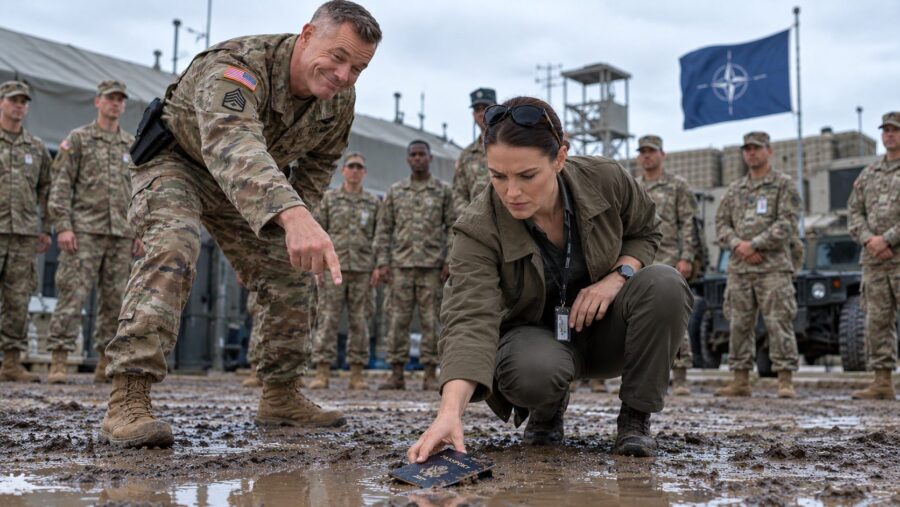
I had introduced myself at the NATO camp as a simple interpreter and contractor responsible for language support.
My badge stated that I spoke English, French, Polish, and Russian.
However, that identity was only a cover.
In reality, I was a general in the U.S. Army.
I had been sent to the base under a false position to discreetly investigate a leak of sensitive information to a foreign network.
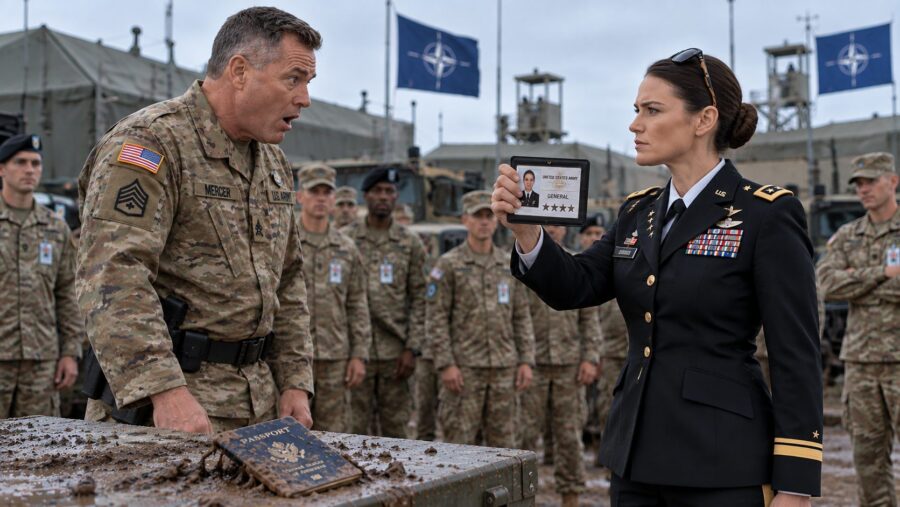
When Command Sergeant Major Mercer threw my passport into the mud, he had no idea who I really was.
My passport represented more than just my American identity: it also carried evidence of my official status and my affiliation with the U.S. military.
But above all, I realized that respect should never have depended on my rank.
Even before my stars were revealed, I deserved the same respect as anyone else.